
1. Interrogate the effects of genetic and environmental crosstalk in the maintenance and breakdown of intestinal homeostasis
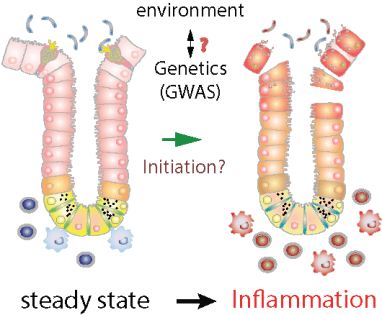
The functional annotation of IBD risk-associated noncoding variants has been limited by their reduced penetrance, which results in subtle or immeasurable effects under steady-state conditions, suggesting that measurable effects might appear only upon exposure to environmental stressors. In particular we are working on:
– Develop novel models of intestinal inflammation.
– Generate IBD reporter zebrafish lines to investigate the function of coding and non-coding IBD risk variants.
– Identify then environmental factors and mechanism by which aberrant intestinal immune responses are triggered in genetically susceptible hosts.
– Characterize the initiation and progression of adaptive commensal-specific T cell responses.
2. Identify novel cellular and molecular mechanisms of tissue regeneration following injury
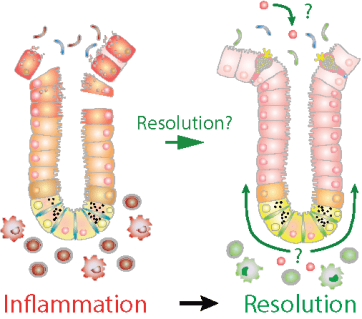
Using unbiased analysis of the immune cell composition, microbiota and transcriptomics during intestinal inflammation and regeneration, we have identified specific immune cells, bugs and pathways that might promote tissue regeneration upon damage. In particular we are working on:
– Characterize and validate candidate genes/pathways and/or cell types with respect to their potential role(s) in tissue regeneration.
– Identify pathways that promote colorectal cancer.
– Further characterize the crosstalk between lymphocytes and the epithelium that modulate intestinal regeneration.
– Gain mechanistic insights into how lymphocytes may support barrier functions.
3. Identifying novel mechanisms of intestinal inflammation and resolution using zebrafish
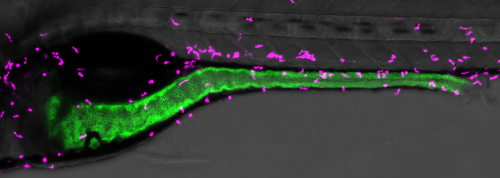
It is widely accepted that the etiology of Inflammatory bowel disease (IBD) lies on the complex crosstalk between genetics, environmental factors, microbiota, and host immune responses. However, the identification of which and how these variables interplay to trigger IBD is limited by the lack of tools and models that allows the cost- and time-effective screening of hundreds of relevant compounds from the environment and microbiota, are genetically tractable, and recapitulate the in vivo intestinal context. In recent years, zebrafish (Danio rerio) have emerged as an attractive model to study human diseases, due to their significant genetic and physiological conservation with humans. In addition, the zebrafish embryo offers unique advantages such as
i) transparency, which enables non-invasive intravital imaging in fluorescently-tagged reporter lines;
ii) external fertilization, that facilitates transient genetic manipulation of fertilized eggs;
iii) large numbers of individuals (~200 embryos/mating pair), iv) small size, allowing their growth in 96-well plates;
v) amenability to test molecules/compounds, as they can be added directly to the immersion water;
vi) compatibility with high-throughput screenings.
By using zebrafish, our lab has identified new environmental risk factors exacerbating intestinal inflammation (Diaz et al., Dis Model Mech. 2021) and new functions of IBD-risk genes in the intestine (Kaya et al., Cell Rep. 2020; Morales et al., Mucosal Immunol. 2022). We are currently developing new zebrafish models of intestinal damage/inflammation and using state-of-the-art transcriptomic technologies to identify novel modulators of intestinal inflammation and resolution, which will be further validated in mouse and humans.
4. The role of B cells in mucosal healing and tumorigenesis
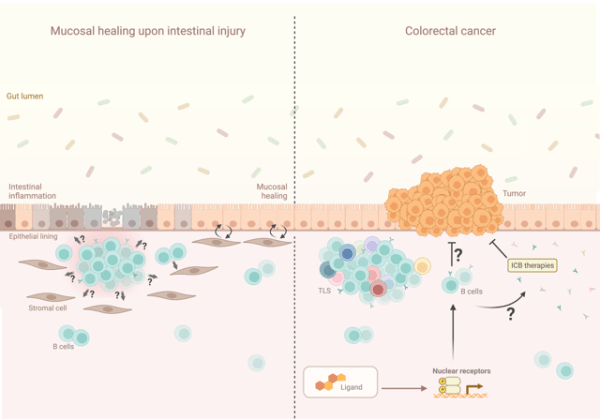
Inflammatory bowel disease (IBD) is a chronic intestinal disorder characterized by a disrupted intestinal barrier that is continually attempting to heal. The constant need for tissue regeneration leads to an elevated risk for the development of intestinal tumors. Attempts to identify cellular and molecular signaling pathways that promote tissue regeneration but not oncogenic transformation have been largely unsuccessful.
A number of recent studies suggest that the accumulation of B cells and tertiary lymphoid structures in the tumor microenvironment correlates positively with improved disease prognosis and response to immune checkpoint blockade (ICB) therapy in various cancer types. However, it is still largely unknown how B cells and tertiary lymphoid structures (TLS) influence intestinal tumorigenesis.
Through a comparative longitudinal transcriptome analysis between intestinal regeneration and tumorigenesis, we have identified new potential targets that separate intestinal regeneration from tumorigenesis. Among other discoveries, we have found B cell gene signatures involved as potential unlikers of intestinal regeneration and tumorigenesis.
In this regard, we recently identified a novel detrimental role of B cells in the healing colon upon acute intestinal injury and showed that expansion of an IFN-induced B cell subset hinders the stromal-epithelial crosstalk required during mucosal healing, thereby slowing intestinal tissue regeneration (Frede A., Czarnewski P., Monasterio G., et al, Immunity, 2022).
Furthermore, we recently found that activation of specific nuclear receptors associated with elevated colonic B cell and TLS emergence in the colon lead to reduced tumor development and dramatic prolongation of survival in pre-clinical models, highlighting the link between a potential anti-tumorigenic role of B cells.
Based on our recent findings, we aim to further:
– Integrate scRNAseq and spatial transcriptomics to enable spatial positioning of clinically relevant pathways
– Investigate the mechanistic and functional involvement of B cells during acute and chronic intestinal inflammation and tumorigenesis
– To characterize cell circuitry and heterogeneity of tertiary lymphoid structures during tumorigenesis
– To investigate whether B cells/TLS modulate response to ICB therapy
5. To determine the heterogeneity of UC
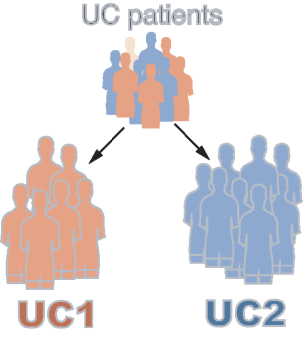
Ulcerative Colitis (UC) is a chronic inflammatory bowel disease (IBD) that is usually confined to the colon. UC is highly heterogeneous, encompassing a wide range of patterns associated with behavior, location, and response to treatment. Despite this heterogeneity, patient classification criteria for tailored therapies are currently lacking. It is vital to characterize the heterogeneity of UC patients to correctly predict if they will respond or not to available treatments and to eventually move towards precision medicine in IBD. Our lab has recently developed an unbiased stratification of UC patients (Czarnewski P. et al., Nat Communications, 2019.) based on their transcriptomic profiles: UC1 patients, which are characterized by a low response (~10%) to biological therapies (infliximab/vedolizumab) and an increased expression of genes associated with neutrophil degranulation and cytokine signaling. While UC2 patients have a higher responsiveness to biological therapy (~60%), and low expression of genes associated with lack of response to anti-TNF treatment. However, to consolidate this novel classification for clinical practice, further characterization is needed. Using multi-omics approaches, such as single cell and spatial transcriptomics, we aim to deeply characterize the immune cell composition and molecular pathways underpinning different UC subsets. This project will provide potential new mechanistic insights into the etiology of IBD and UC therapy management. Therefore we are still working to:
– Further characterize UC1 patients and identify therapeutic targets to either promote remission or make them responders (e.g. conversion into UC2).
– Generate an affordable diagnostic tool that can be used to identify UC1 and UC2 patients.
– Further characterize UC1 and UC2 patients using other “omic” approaches (e.g. microbiome, CyTOFF, etc).
– To perform cross-species comparisons of different processes associated with IBD, such as acute intestinal inflammation and mucosal healing.
 Villablanca Lab | KI