
Postdoctoral position open to study:
(computational biologist)
Molecular and cellular circuits in the gastrointestinal tract using spatial multi-omics approaches
The Villablanca Lab is trying to understand the molecular and cellular mechanisms involved in the establishment of intestinal immune homeostasis and how a breakdown of these mechanisms may lead to immune mediated inflammatory diseases (IMID). Our aim is to interrogate cell composition and function during intestinal damage, regeneration and tumorigenesis using experimental models of inflammation and NGS approaches. In particular, the candidate will analyze and integrate microbiota, single cell RNAseq (SC), spatial transcriptomics (ST), in situ sequencing (ISS) and CODEX datasets to visualize omics landscapes at the topographic level. This position is an exciting opportunity to work on the cutting-edge of mucosal immunology field utilizing computational biology and data visualization tools. The candidate will be part of a multidisciplinary team actively working with renowned collaborators around the globe. The Karolinska Institute provides a vibrant academic ecosystem with close links to top academics who are pioneers in spatial transcriptomics and scRNA-seq-based methodologies. This project is funded by the Wallenberg foundation, Cancerfonden, the Swedish Research Council and ERC-SyG.
Entry requirements: The Villablanca Lab (Karolinska Institutet) have opportunities for highly creative and motivated postdoctoral bioinformaticians with an interest in mucosal immunology. The candidate is expected to become an expert in single cell genomics and spatial transcriptomics pipelines and in the evaluation of novel methodologies. In addition, the candidate will be responsible for the development, enhancement, and maintenance of the scRNA-seq program in the lab. A person is eligible for a position as postdoctoral researcher if he or she has obtained a PhD no more than seven years before the last date of postdoc employement.
Specific requirements
Expertise in scripting language (e.g. R, Python)
Formal programming language (e.g. Java)
Expertise in mucosal immunology
Big data processing pipelines
Computational biology
Fluency in both spoken and written English
Application documents:
- An application letter and curriculum vitae
- A copy of degree certificates and any other relevant certificates
- A copy of degree projects and previous publications
- Two reference letters
For more information, please contact: eduardo.villablanca@ki.se
Publications related to this position.:
Das et al, Nature, 2025, doi: 10.1038/s41586-024-08247-6
Monasterio et al, Nature Protocols, 2024, doi: 10.1038/s41596-024-01001-2
Parigi et al., Nat Commun, 2022, doi: 10.1038/s41467-022-28497-0
Frede A., et al., Immunity, 2022, doi: 10.1016/j.immuni.2022.11.002.
Czarnewsky P., Nat Commun,2019, doi: 10.1038/s41467-019-10769-x
Apply: Link to the position
Postdoctoral position in mucosal immunology
Exploring the Immune Landscape of Mucosal Tissues
The Villablanca Lab at Karolinska Institutet is seeking a highly motivated postdoctoral researcher to join our team in studying immune responses in mucosal tissues. Our lab focuses on understanding the molecular and cellular mechanisms that maintain immune homeostasis and their implications for inflammatory diseases. This position offers an exciting opportunity to work at the intersection of immunology, cellular biology, and molecular techniques in a dynamic and collaborative research environment. This project is funded by the Wallenberg foundation (KAW research grant) and ERC-SyG.
Who We Are Looking For:
We are searching for a creative and independent researcher with a strong background in immunology, molecular biology and colitis and colorectal experimental models. The ideal candidate will be eager to contribute to ongoing research projects and collaborate with national and international partners. The candidate will possess: i) a degree in biology, or biotechnology, or medicine or any other biological sciences. ii) A completed or about to complete PhD in cellular and molecular biology or molecular Medicine or Immunology. iii) Excellent level of spoken and written English
Required expertise:
- Spectral flow cytometry
- Multiplex tissue staining
- In vivo colitis and colorectal cancer
- Cell isolation from tissue
- Molecular biology
Application process:
- An application letter and curriculum vitae
- A copy of degree certificates and any other relevant certificates
- A copy of degree projects and previous publications
- Two reference letters
For more information, please contact: eduardo.villablanca@ki.se
Publications related to this position.:
Das et al, Nature, 2025, doi: 10.1038/s41586-024-08247-6
Sorini et al, Mucosal Immunol, 2023, doi: 10.1016/j.mucimm.2023.11.001
Monasterio et al, Nature Protocols, 2024, doi: 10.1038/s41596-024-01001-2
Parigi et al., Nat Commun, 2022, doi: 10.1038/s41467-022-28497-0
Postdoctoral position open to study:
(computational biologist)
The transcriptomic landscape of the intestinal barrier
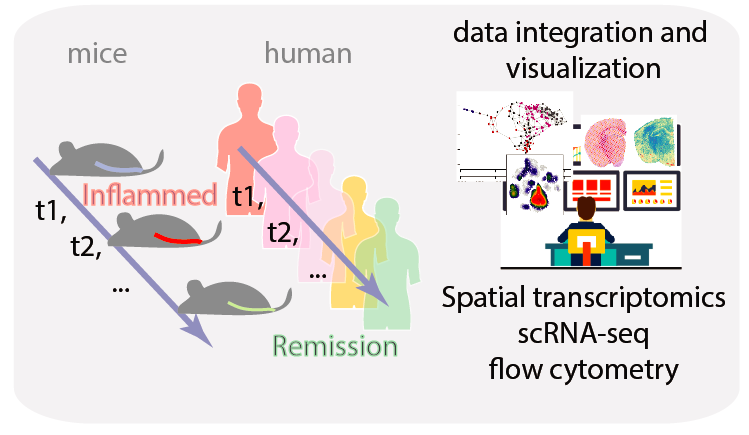
Transcriptomic analysis at the single-cell level has revolutionized our understanding of the immune system and enabled the discovery of novel immune cell types (or subtypes) activation state in health and disease. The Villablanca Lab is trying to understand the molecular and cellular mechanisms involved in the establishment of intestinal immune homeostasis and how a breakdown of these mechanisms may lead to immune-mediated inflammatory diseases (IMIDs). Our aim is to interrogate cell composition and function using experimental models of inflammation and taking scRNA-seq approaches. As a highly complementary approach, we are now performing spatial transcriptomics allowing us the visualization of transcriptional landscapes at the topographic level. This position is an exciting opportunity to work on the cutting-edge of the mucosal immunology field utilizing computational biology and data visualization tools. The candidate will be part of a multidisciplinary team actively working with renowned collaborators around the globe. The Karolinska Institute provides a vibrant academic ecosystem with close links to top academics who are pioneers in spatial transcriptomics and scRNA-seq-based methodologies. This project is funded by the Wallenberg foundation, Cancerfonden, and the Swedish Research Council.
Entry requirements: The Villablanca Lab (Karolinska Institutet) have opportunities for highly creative and motivated postdoctoral bioinformaticians with an interest in mucosal immunology. We are looking for a candidate with proficiency and documented laboratory research experience, particularly in immune cell biology and bioinformatics analysis. The candidate is expected to become an expert in single-cell genomics and spatial transcriptomics pipelines and in the evaluation of novel methodologies. In addition, the candidate will be responsible for the development, enhancement, and maintenance of the scRNAseq program in the lab. Fluency in both oral and written English is necessary. A person is eligible for a position as a postdoctoral researcher if he or she has obtained a Ph.D. no more than seven years before the last date of postdoc employment. The candidate must enjoy collaborating with other scientists.
Specific requirements
Expertise in scripting language (e.g. R, Phyton)
Formal programming language (e.g. Java)
Expertise in mucosal immunology
Big data processing pipelines
Application documents:
- An application letter and curriculum vitae
- A copy of degree certificates and any other relevant certificates
- A copy of degree projects and previous publications
For more information, please contact: eduardo.villablanca@ki.se
Publications: Frede A., et al., Immunity, 2022; Parigi S.M., et al., Nat Commun, 2022; Czarnewsky P., Nat Commun, 2019; Peloquin J.M., et al., Annu Rev Immunol, 2016; Villablanca EJ, et al., Gut, 2014; Villablanca EJ, et al., Gastroenterology, 2011; Villablanca EJ, et al., Nat Med, 2010.
Postdoctoral Fellow wanted!
“Using zebrafish to study the impact of gene-environment interactions in inflammatory bowel diseases”
Description: The environment plays a critical role triggering disease in genetically susceptible individuals. The goal of this project is to generate in vivo models to study the interaction between gene function and environmental factors during the initiation/resolution of intestinal inflammation. We have generated CRISPR mutant zebrafish lines targeting IBD-risk genes with unknown function. The successful candidate will characterize these mutants and validate her/his finding in mouse models and human organoids candidate will also generate IBD reporters to visualize immunological processes associated to IBD in the context of genetic susceptibility and environmental triggers.
Entry requirements: Our lab has an opening for a highly creative and motivated postdoctoral scientist with an interest in mucosal immunology. We look for a candidate with proficiency and documented laboratory research experience particularly in molecular biology, in vivo imaging and genetic manipulation in zebrafish. The candidate is expected to work with both zebrafish and mouse models of intestinal inflammation. Experience in bioinformatics and RNA-seq analysis would be an advantage. The position will require independent work at the laboratory as well as extensive collaboration with other experimental groups. Fluency in both oral and written English is necessary. Documented ability to analyze and present results orally and written is important.
Type of scholarship: A scholarship for carrying out postdoctoral research can be granted for a maximum of two years within a four year perid following the receipt of a doctoral degree or equivalent. This educational scholarship is tax-exempt. The amount is set for twelve months at a time and is paid out on a monthly basis. In exceptional cases, shorter periods may be acceptable.
 Villablanca Lab | KI